
The Science
Clarity isn’t random. It is designed.
The research behind the design of the week: what each study found, what it means for someone carrying high-stakes decisions — and where it shows up in Furnas.
The thesis
Intelligence was never the bottleneck.
Sustained pressure doesn’t just create stress. It quietly degrades decision-making — not through single bad calls, but through a slow drift of slightly worse ones, repeated daily.
The instinct, when a decision won’t resolve, is to add more thinking: another model, another adviser, another late night. The evidence points the other way. When researchers looked back at more than a thousand major business decisions, the way a decision was made counted for far more than the analysis behind it.9
Capable people are rarely short of intelligence. They are short of the conditions that let it work: a regulated body, distance from the problem, and a room that will tell them the truth.
So we don’t add more thinking. We design the conditions.
Breathe
You can’t think your way to clarity in a stressed body. The body gets there first.
5mina day of structured breathing
The finding
Five minutes a day of cyclic sighing (two inhales through the nose, one long exhale through the mouth) improved mood and reduced physiological arousal more than mindfulness meditation. The practice that stood out: cyclic sighing — two inhales through the nose, one long exhale through the mouth.
1Balban, Spiegel, Huberman et al. · Cell Reports Medicine, 2023 (opens the source in a new tab)
What it means for a decision-maker — Breathe
Your physiological state sets the terms before your thinking does. A body that has been running hot for months narrows what you notice and pulls you towards reactive choices.
The long exhale is one of the few levers on that state you can pull deliberately — in a minute, anywhere, before the meeting where the decision gets made.
How it shows up in Furnas — Breathe
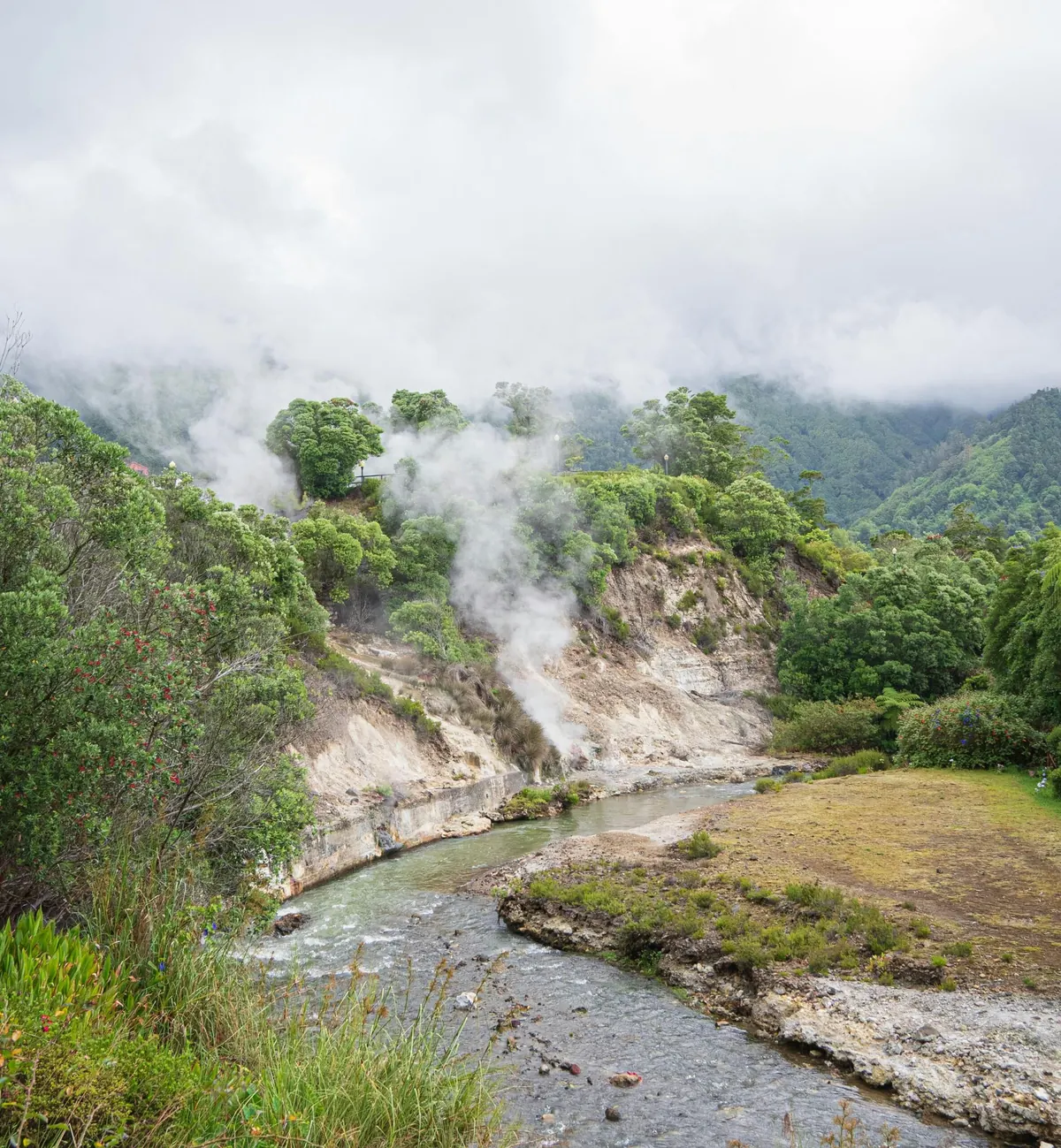
The week starts with the body. Samir Javed, a Level 3 Wim Hof Method instructor, leads breathwork and cold exposure as tools for regulation — a deliberate stress, met calmly. The thermal springs are where the physiological reset begins: before the breathwork, before the cold.
The trial’s standout practice was cyclic sighing, which you can try here. The Wim Hof Method is a different practice, used in Furnas for the same first purpose: regulate the body, then think.
Move
Your best decision will not happen at your desk.
60%more creative output, walking versus sitting
The finding
Walking boosted creative output by around sixty per cent compared with sitting still.
2Oppezzo & Schwartz · Journal of Experimental Psychology: Learning, Memory, and Cognition, 2014 (opens the source in a new tab)
90minin nature, and rumination fell
The finding
A ninety-minute walk in nature measurably reduced rumination — the loop your brain runs when a decision won’t resolve.
3Bratman et al. · PNAS, 2015 (opens the source in a new tab)

What it means for a decision-maker — Move
A hard call held at a desk tends to tighten. Movement gives the mind enough distance from a problem that it stops gripping so hard — and in open, green space, the loop it has been running begins to quieten.
The point isn’t exercise. It’s distance.
How it shows up in Furnas — Move
Somatic movement and yoga with Carolina Lino, to restore the body’s capacity to regulate. Walks and hikes in raw nature. Jorge Valerio’s handpan and sound in the landscape — the bridge between physical regulation and stillness.
Movement that slows thinking down, rather than speeding it up.
Connect
Your next decision is only as good as the room you make it in.
The finding
Group intelligence is real and measurable — and has little to do with the smartest person in the room. It depends on how the group talks: who listens, and whether everyone gets a turn.
4Woolley et al. · Science, 2010 (opens the source in a new tab)
85yearsof the Harvard Study of Adult Development
And what it is all for
Over 85 years, the quality of close relationships proved the strongest predictor of long-term wellbeing.
5Harvard Study of Adult Development (opens the source in a new tab)
What it means for a decision-maker — Connect
The more senior you get, the smaller the room becomes. People manage you instead of talking to you, and most of your relationships are built on alignment, not friction. Nobody on your organisation chart is incentivised to tell you the decision is wrong.
The Harvard finding isn’t about decisions. It is about what they are for.
How it shows up in Furnas — Connect
Eight people with the earned right to an honest conversation. Guided sessions and decision councils, where the room asks the questions your usual circle won’t.
Anchored by cozido das Furnas — slow-cooked underground for six hours. The most unhurried table you will ever sit at.
From Field Notes · the protocol
- The more senior you get, the smaller that room becomes. What research on group intelligence says about who you decide with — and why we cap it at eight. 5 min read — Your next decision is only as good as the room you make it in.
- On cozido das Furnas — six hours in the volcanic ground, no chef, no flame — and what a slow meal teaches a room about honest conversation. 4 min read — The most unhurried table you will ever sit at.
Place
The place that made the problem cannot solve it.
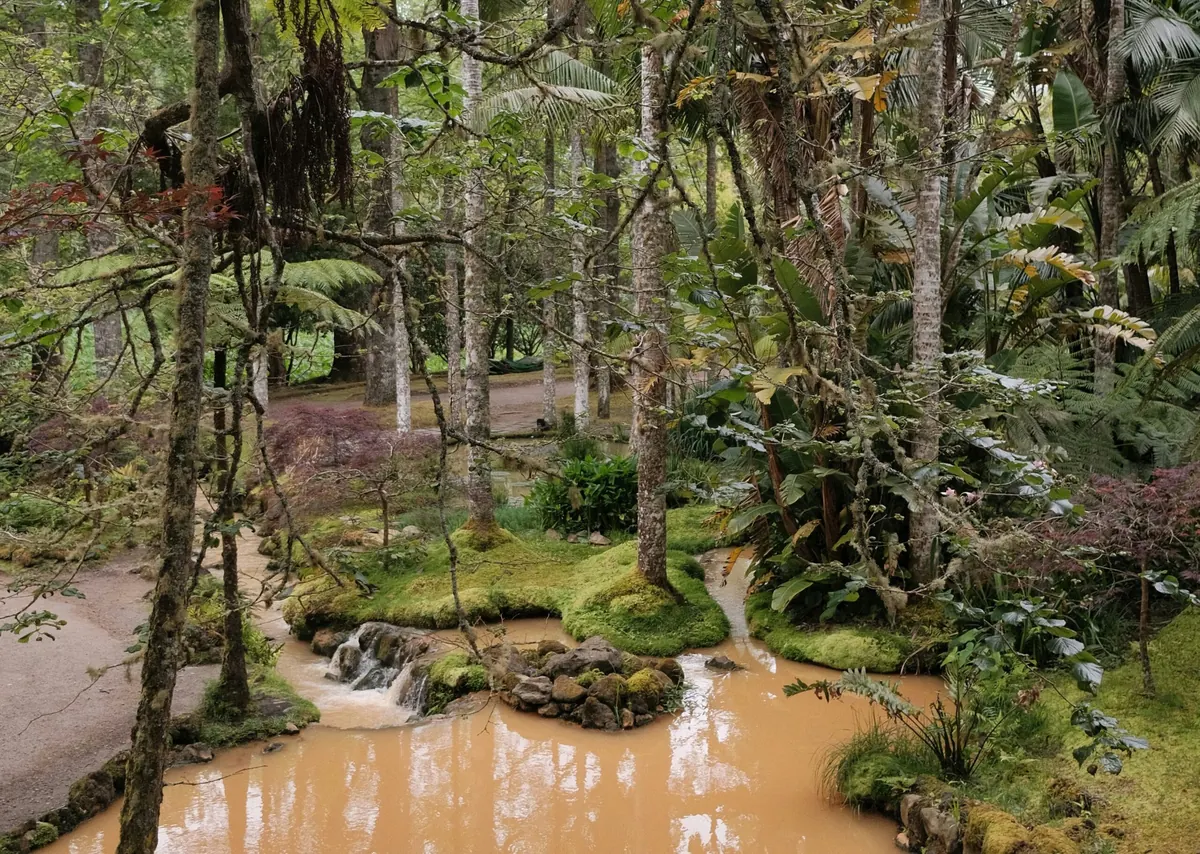
50%better creative problem-solving
The finding
Four days immersed in nature, disconnected from devices, improved creative problem-solving by fifty per cent.
6Atchley, Strayer & Atchley · PLoS ONE, 2012 (opens the source in a new tab)
Attention Restoration Theory
Cities spend attention. Nature restores it.
7Kaplan · Attention Restoration Theory (opens the source in a new tab)
Construal-level theory
Distance changes the size of the questions you can think about.
8Trope & Liberman · Psychological Review, 2010 (opens the source in a new tab)
What it means for a decision-maker — Place
The problem was made at your desk, in your calendar, between your meetings. Every hour spent there spends the attention you need to see it clearly.
Distance works the other way. Step far enough from the problem and it starts to show its real size.
How it shows up in Furnas — Place
A geothermal valley in the east of São Miguel, in the middle of the Atlantic. Private cabins tucked into the forest. Thermal water rising from deep below. Remote enough to force a genuine break — and five days, not an afternoon.
We can’t promise you the study’s number. We can give you what it points to: days, not hours, immersed in nature — far from the desk where the problem was made.
Method
Intelligence was never the bottleneck. The absence of a genuine outside challenge was.
6×process over analysis
The finding
Across more than 1,000 major business decisions, the decision process mattered roughly six times more than the quality of the analysis.
9Lovallo & Sibony · McKinsey Quarterly, 2010 (opens the source in a new tab)
Quality of the analysis
1×
The decision process
≈ 6×
Relative importance, as reported by Lovallo & Sibony, McKinsey Quarterly, 2010.
What it means for a decision-maker — Method
You did not reach the top by being wrong often. That is exactly the trap. The sharper your mind, the better it defends the decision you have already made — and more analysis only hands it better arguments.
What changes the outcome is the process: a structured outside challenge you can’t argue your way around.
How it shows up in Furnas — Method
The coach brings the method. Rob Paynter — twenty years inside C-suites, specialising in decision-making under uncertainty — begins with a private calibration 7–14 days before you arrive.
On the island, the room pressure-tests your thinking. You do the deciding.
Outcome
A retreat sends you home relaxed. A mastermind sends you home with notes. Neither sends you home certain.
Yours.A goal that matters to you
The finding
Goals change behaviour when people are committed to them — and commitment grows when the goal truly matters to you and you believe you can deliver it.
10Locke & Latham · American Psychologist, 2002 (opens the source in a new tab)
What it means for a decision-maker — Outcome
Advice is easy to set down the moment the week gets loud. Commitment is not — and commitment has two conditions. The goal has to matter to you, and you have to believe you can deliver it.
Another opinion rarely supplies either. Clarity on what actually matters does, and so does a plan tested hard enough that you trust it.
How it shows up in Furnas — Outcome
Calibration with Rob Paynter names the decision that matters before you arrive. On the island, the room pressure-tests the plan until you can stand behind it. Nobody hands you an answer. You do the deciding.
A private calibration after the reset helps the decision survive contact with your calendar. You leave knowing exactly what to do next, and fully behind it.
Sound
Furnas is never silent. That is the point.
Water.The strongest effect on health outcomes
The finding — a review of the research
Natural sounds lower stress and lift positive feelings. Water sounds showed the strongest effect on health outcomes.
11Buxton et al. · PNAS, 2021 (opens the source in a new tab)

What it means for a decision-maker — Sound
Most working days are spent inside manufactured noise: notifications, traffic, the next call. You stopped noticing it years ago. Not noticing it is not the same as not hearing it.
How it shows up in Furnas — Sound
The sound of the forest and the earth below. Jorge Valerio’s handpan in the landscape. And each day’s programme closes with a sound bath — Nuno Amendoeira has worked with Tibetan singing bowls since 2005. A space to pause, release and return to yourself.
From evidence to the week
Every finding has a place in the day.
Body first, then movement, then the room. Here is where each piece of research lives — before you arrive, across five days in Furnas, and after you leave.
Before you arrive
-
Method
Calibration
A private session with Rob Paynter, 7–14 days before you arrive. Name the decision. Set the intention.
Five days in Furnas*
The whole week rests on place — Atchley et al.; Kaplan; Trope & Liberman. The shape of a typical day below — every cohort is tailored.
-
Breathe
Body first
Breathwork and cold exposure with Samir Javed. Thermal water, where the physiological reset begins.
-
Move
Movement
Somatic movement and yoga with Carolina Lino. Walks in raw nature.
-
Connect · Method
The room
Eight peers. Guided sessions and decision councils that pressure-test your thinking.
-
Connect
The table
An unhurried table, anchored by cozido das Furnas — slow-cooked underground for six hours.
-
Sound
Sound
Handpan in the landscape. A sound bath closes each day’s programme.
After you leave
-
Outcome
Integration
A private calibration after the reset, so a decision you are committed to survives contact with your calendar.
*Each experience is tailored to each cohort.
Field Notes
Read for the science — and the protocol.
Every finding here has a practice behind it. Field Notes turn the research into short protocols you can run this week, wherever you are — each lever above links to its own.
The full version happens in Furnas.
References
The sources, in full.
-
01
Breathe
Balban, M.Y., Neri, E., Kogon, M.M., Weed, L., Nouriani, B., Jo, B., Holl, G., Zeitzer, J.M., Spiegel, D. & Huberman, A.D. (2023). Brief structured respiration practices enhance mood and reduce physiological arousal. Cell Reports Medicine, 4(1), 100895.
doi.org/10.1016/j.xcrm.2022.100895 (opens in a new tab) -
02
Move
Oppezzo, M. & Schwartz, D.L. (2014). Give your ideas some legs: The positive effect of walking on creative thinking. Journal of Experimental Psychology: Learning, Memory, and Cognition, 40(4), 1142–1152.
doi.org/10.1037/a0036577 (opens in a new tab) -
03
Move
Bratman, G.N., Hamilton, J.P., Hahn, K.S., Daily, G.C. & Gross, J.J. (2015). Nature experience reduces rumination and subgenual prefrontal cortex activation. Proceedings of the National Academy of Sciences, 112(28), 8567–8572.
doi.org/10.1073/pnas.1510459112 (opens in a new tab) -
04
Connect
Woolley, A.W., Chabris, C.F., Pentland, A., Hashmi, N. & Malone, T.W. (2010). Evidence for a collective intelligence factor in the performance of human groups. Science, 330(6004), 686–688.
doi.org/10.1126/science.1193147 (opens in a new tab) -
05
Connect
Harvard Study of Adult Development — more than 85 years of research. Findings summarised in Waldinger, R. & Schulz, M. (2023). The Good Life.
adultdevelopmentstudy.org (opens in a new tab) -
06
Place
Atchley, R.A., Strayer, D.L. & Atchley, P. (2012). Creativity in the wild: Improving creative reasoning through immersion in natural settings. PLoS ONE, 7(12), e51474.
doi.org/10.1371/journal.pone.0051474 (opens in a new tab) -
07
Place
Kaplan, S. (1995). The restorative benefits of nature: Toward an integrative framework. Journal of Environmental Psychology, 15(3), 169–182. A foundational paper of Attention Restoration Theory.
doi.org/10.1016/0272-4944(95)90001-2 (opens in a new tab) -
08
Place
Trope, Y. & Liberman, N. (2010). Construal-level theory of psychological distance. Psychological Review, 117(2), 440–463.
doi.org/10.1037/a0018963 (opens in a new tab) -
09
Method
Lovallo, D. & Sibony, O. (2010). The case for behavioral strategy. McKinsey Quarterly.
mckinsey.com/capabilities/strategy-and-corporate-finance/our-insights/the-case-for-behavioral-strategy (opens in a new tab) -
10
Outcome
Locke, E.A. & Latham, G.P. (2002). Building a practically useful theory of goal setting and task motivation: A 35-year odyssey. American Psychologist, 57(9), 705–717.
doi.org/10.1037/0003-066X.57.9.705 (opens in a new tab) -
11
Sound
Buxton, R.T., Pearson, A.L., Allou, C., Fristrup, K. & Wittemyer, G. (2021). A synthesis of health benefits of natural sounds and their distribution in national parks. Proceedings of the National Academy of Sciences, 118(14), e2013097118.
doi.org/10.1073/pnas.2013097118 (opens in a new tab)

October 2026 · Fully bookedLimited places each year
The conditions are designed. The decision is yours.
We respond to every enquiry personally within 48 hours. This is not a booking form — let’s have a conversation.
Or write to us directly — reset@theneighbourshub.com