Early in a career, you are surrounded by people who will tell you when you are wrong. Peers argue with you. Managers correct you. Nobody has much reason to protect your feelings. Then you rise, and the room changes shape. Everyone is still talking to you. Fewer and fewer are talking to you honestly.
It is not malice. It is structure. When your decision shapes someone’s budget, team or bonus, every conversation with you carries a calculation. The higher you climb, the more of your conversations become negotiations — and the fewer people are left who have nothing to gain.
Everyone is managing you. Almost nobody is talking to you.
A group has an intelligence of its own
In 2010, a team led by Anita Woolley at Carnegie Mellon, working with colleagues at MIT, published a study in Science that asked a simple question: is there such a thing as a group’s intelligence, separate from the intelligence of its members? They put people into small groups and gave them a wide variety of tasks.
There was. A single factor — they called it c, for collective intelligence — predicted how well a group would perform across very different problems. And it was not strongly correlated with the average intelligence of the members, or with the intelligence of the smartest person in the room.
What it did track was how the group talked. Groups did better when their members were more socially sensitive — better at reading one another — and when the conversation was shared more evenly. Groups where a few voices dominated were collectively less intelligent.
The room you have
The filled seat is you. Every line of conversation runs through it.
The room you need
Turns shared evenly. Nobody to manage, nobody to impress.
Read that as a senior leader and it is uncomfortable. The meeting you chair, where most of the talking flows through you, is precisely the shape the research suggests makes a group less intelligent. Being the smartest person at the table does not rescue it; in the study, that barely registered. The shape of the conversation did.
Why eight, and why a table
Close relationships are not a soft extra. The Harvard Study of Adult Development has followed the same group of people — and now their children — for more than 85 years. Over that time, the quality of their close relationships proved the strongest predictor of long-term health and happiness. Not how many relationships they had: the quality of the close ones. The quality of the room matters long after any single decision.
We cap each cohort at eight. Large enough for genuinely different perspectives; small enough that everyone speaks, everyone is heard, and nobody can hide in the audience. Eight founders and executives with the earned right to an honest conversation — and no stake in one another’s organisations.
That distance is what makes the simplest questions work. Why this? Why now? What are you not saying? Inside your company, each of those carries politics. From a peer with nothing to gain, they are just questions, and they land differently. It is the outside challenge that, as we wrote in The slow drift, most senior leaders quietly lose.
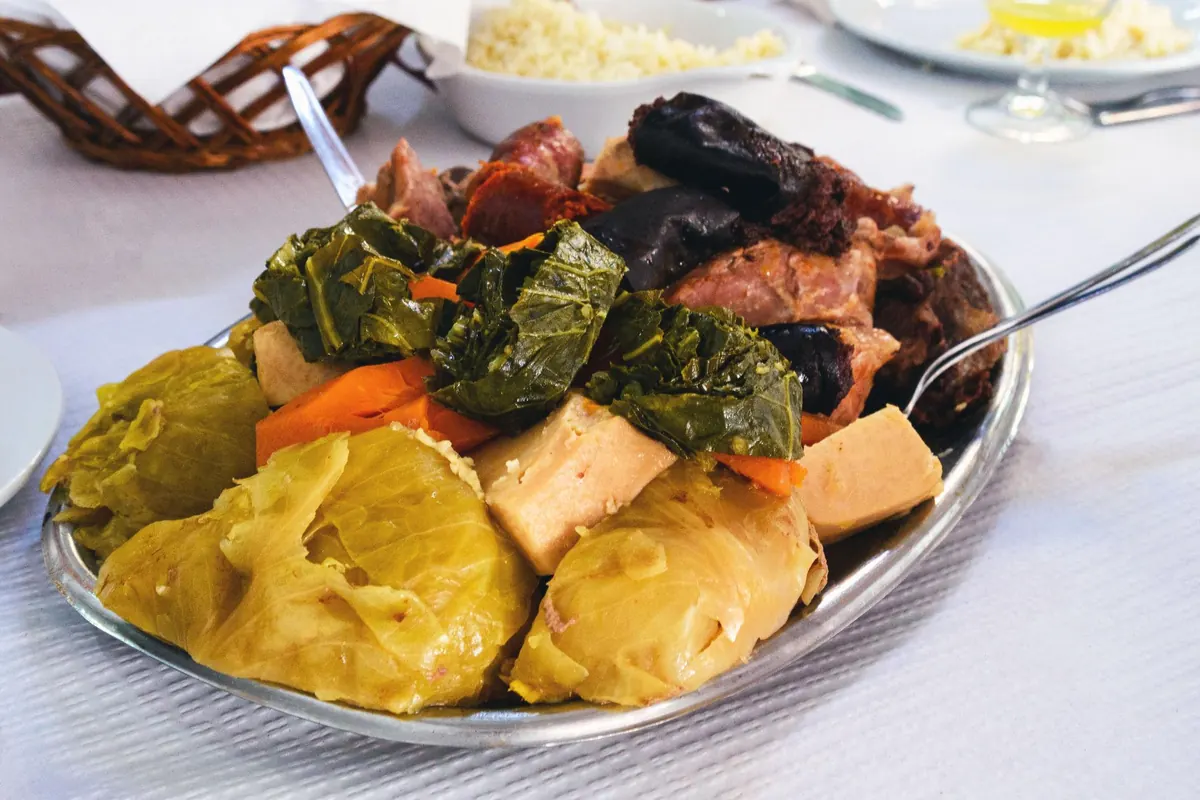
It is also why the week is anchored by a table. Cozido das Furnas is slow-cooked underground for six hours by geothermal heat — no chef, no kitchen, no flame. You cannot hurry it, so nobody tries. It is the most unhurried table you will ever sit at, and the conversations it holds are not the ones you have in a boardroom.
No cameras. No audience. No record.
Honest conversation requires no audience. The moment a room can be recorded, people perform instead of reset. So nothing said at the table leaves it, and no guest’s face ever appears in anything we publish.
Privacy is not a courtesy here. It is the condition that makes the work possible.